
The Capacity Illusion
When a food manufacturer approaches its production limits, the conversation often turns quickly to capital investment. Another production line, additional shifts, new automation, expanded warehouse space, or even a new facility may appear to be the logical response to growing demand.
But what if the capacity you need is already there?
Across food and beverage manufacturing, significant productive capacity is often consumed by activities that add little or no value: unplanned downtime, excessive changeovers, quality losses, material waste, rework, inefficient staffing, and unstable production schedules.
These losses represent what is commonly called the hidden factory—the resources, time, and money consumed compensating for processes that do not consistently perform as intended.
The hidden factory is not a separately recorded asset. Its costs are dispersed through labor, materials, maintenance, freight, and other operating expenses, often accepted as part of doing business.
The opportunity is not simply to eliminate waste. It is to convert existing operating resources into additional earnings, improved service, and greater financial flexibility.
Where the Hidden Factory Lives
The hidden factory rarely exists in one department. It is typically spread across multiple functions, with costs that reinforce one another.
1. Equipment Reliability and Unplanned Downtime
Production lines rarely sustain their designed operating rates throughout a shift. Mechanical failures, minor stops, material interruptions, and inconsistent operating practices consume productive time.
The impact extends beyond lost output. Downtime often creates overtime, schedule changes, additional changeovers, and customer service disruptions.
2. Yield Loss, Giveaway, and Rework
Material losses can be particularly expensive in food manufacturing, where ingredients often represent a substantial portion of product cost.
Overweight packages, excessive trim, startup waste, formulation variability, rejected batches, and rework reduce the amount of saleable product generated from purchased materials.
Even modest improvements in yield can generate meaningful financial benefits in high-volume operations.
3. Changeovers and Schedule Instability
Growing SKU assortments, promotional activity, and changing customer priorities can significantly reduce effective manufacturing capacity.
Poor sequencing, incomplete material availability, and last-minute schedule changes amplify these losses.
What appears to be a manufacturing efficiency problem may actually originate in sales, demand planning, procurement, or commercialization.
4. Labor Inefficiency and Process Variability
Labor requirements often increase as processes become less predictable.
Additional employees may be assigned to compensate for unreliable equipment, inconsistent quality, inadequate material flow, or excessive manual intervention.
The problem is not necessarily the workforce. Frequently, it is the operating system surrounding that workforce.
5. Inventory and Working Capital
Inventory is often used to protect the business from unreliable processes.
Manufacturers build additional finished goods to compensate for unpredictable schedules, carry excess raw materials to protect against supply interruptions, or maintain work-in-process buffers between operations.
These practices consume cash, warehouse capacity, and management attention while masking underlying operating problems. Reducing inventory can release working capital; it does not automatically increase EBITDA. Related storage, handling, or obsolescence expense reductions may improve earnings.
6. Commercialization and Product Complexity
New products and customer requirements are essential to growth, but complexity is not free.
Poorly managed product introductions can create excess inventory, production interruptions, additional changeovers, quality challenges, and obsolete materials.
When product profitability does not adequately reflect these operational costs, growth can actually dilute margins.
Connecting Operational Performance to EBITDA
The most important question is not simply how much waste exists.
It is: How much financial value can be recovered, and what will it take to capture it?
Consider a hypothetical food manufacturer generating $150 million in annual revenue with a 10% EBITDA margin.
That business produces $15 million in annual EBITDA.
Suppose an operational review identifies the following recurring, avoidable costs:
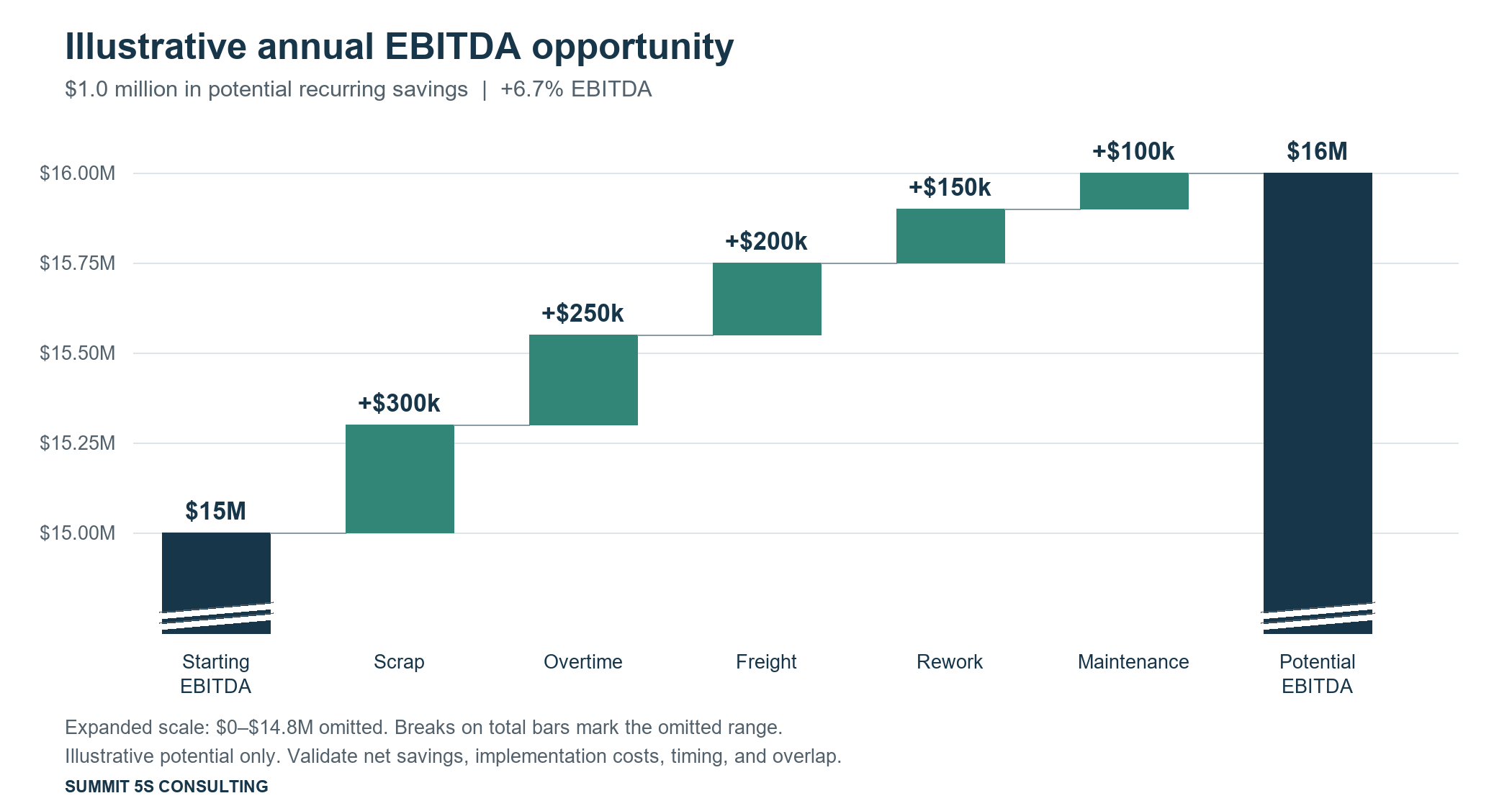
Illustrative annual opportunities, not a client result or forecast. Validate the baseline, timing, recurring net savings, and implementation costs; separate scrap from rework and avoid counting the same labor or disruption savings twice. Maintenance savings must come from preventing failures and avoidable repairs while preserving required preventive maintenance, food safety, and asset integrity.
If fully realized as recurring net expense reductions, these improvements would increase annual EBITDA from $15 million to $16 million—approximately a 6.7% increase without adding revenue. Implementation costs can reduce or delay the benefit, particularly in the first year.
The EBITDA margin would improve from 10.0% to approximately 10.7%.
This analysis does not assign additional value to productive capacity recovered through better reliability, faster changeovers, or improved schedule adherence.
Recovered capacity can create incremental earnings where it relieves a system constraint and profitable customer demand exists. Available time on a non-constraining asset does not necessarily increase plant output. Any incremental volume benefit should be evaluated separately from the expense savings above.
For private equity-backed businesses, sustained EBITDA improvements can also increase enterprise value, depending on the valuation multiple and quality of earnings.
Additional benefits may come from reduced working capital requirements and the avoidance or deferral of capital expenditures.
The hidden factory represents more than an efficiency opportunity. It can be a meaningful source of enterprise value creation.
Why Traditional Improvement Programs Often Underperform
Most manufacturers are familiar with Lean manufacturing, continuous improvement, OEE, and waste reduction.
The challenge is rarely a lack of tools.
More often, it is the absence of an integrated management approach connecting operational performance, cross-functional decisions, and financial accountability.
A manufacturing team may improve line efficiency while the commercial organization continues introducing products without understanding their operational impact.
Procurement may achieve favorable material pricing while introducing variability that increases manufacturing losses.
Operations may improve apparent production efficiency through longer campaigns while creating excess finished goods inventory.
Each function can appear successful against its own objectives while the enterprise experiences little meaningful financial improvement.
Sustainable improvement requires managing the business as an interconnected system rather than optimizing individual departments in isolation.
The objective is not simply better manufacturing metrics. It is better business performance.
Finding the Hidden Factory: A Focused Operational Diagnostic
An initial assessment of improvement opportunities need not require months of analysis. A focused scope and access to reliable operating information can make a rapid diagnostic practical.
Experienced operational leadership, combined with focused data analysis and direct observation, can often identify significant opportunities quickly.
For a single manufacturing facility, a focused initial diagnostic can often be completed in 5–10 business days, depending on site complexity, scope, access to the team, and the availability and quality of operating information. This is a timeframe for identifying and prioritizing opportunities, not for realizing the full savings.
The purpose is not to study everything.
It is to identify where the business is losing value, estimate the financial opportunity, and establish clear priorities for action.
A focused diagnostic typically includes five elements:
1. Establish the Financial and Operational Baseline
Review available financial results, production performance, labor costs, material losses, downtime, and inventory.
Identify the most significant gaps between expected and actual results.
2. Observe Operations and Engage the Team
Spend time on the manufacturing floor.
Observe production, material flow, changeovers, maintenance practices, and daily management routines.
Engage operators, supervisors, and functional leaders to understand recurring problems and the workarounds that have become accepted practice.
3. Identify Cross-Functional Sources of Loss
Examine how decisions in planning, procurement, commercialization, quality, and maintenance affect manufacturing performance.
Look beyond symptoms to identify the underlying causes of recurring losses.
4. Quantify and Prioritize Opportunities
Develop preliminary estimates of recoverable financial value.
Distinguish immediate opportunities from improvements requiring additional investigation, investment, or organizational change.
Prioritize actions based on financial impact, feasibility, time to value, and execution risk.
5. Deliver a Practical Action Plan
Provide leadership with a concise summary of findings, estimated financial opportunities, and recommended next steps.
Identify actions that can begin immediately, establish accountable ownership, and define how improvements will be measured.
The deliverable is not an exhaustive consulting report.
It is a practical, financially grounded roadmap identifying where value can be recovered, what should be done first, and which opportunities justify further investment.
The initial diagnostic identifies and prioritizes opportunities; realizing and sustaining the full financial benefit requires disciplined execution.
Let the First Improvements Fund the Next Ones
One of the most attractive aspects of recovering hidden-factory losses is the opportunity to use early gains to finance additional improvements.
Reducing material waste, overtime, or expedited freight may generate savings relatively quickly.
Those savings can then support more substantial investments in equipment reliability, operator training, process controls, planning capabilities, and targeted automation.
As reliability and process capability improve, additional capacity becomes available. More predictable production reduces inventory requirements and improves customer service.
The result can become a virtuous cycle:
Better process control supports reliability and productivity. Sustained operating gains can improve margins and cash flow, creating funds to reinvest in capability.
This approach also strengthens the business case for automation.
Rather than automating an unstable or poorly understood process, the organization first establishes how the operation should perform, eliminates unnecessary complexity, and then invests where technology will create sustainable value.
Before You Invest in More Capacity, Understand the Capacity You Already Own
Additional equipment, facilities, and automation will always play an important role in supporting growth.
But capital investment should follow a clear understanding of the capabilities and constraints of existing operations.
For manufacturers confronting margin pressure, growth challenges, or increasing operational complexity, the hidden factory may represent one of the most attractive sources of near-term value creation.
And identifying that opportunity need not require a major commitment.
A focused operational diagnostic, grounded in experienced leadership and practical financial analysis, can provide meaningful insight in days rather than months.
The opportunity may already exist inside the business. The challenge is making it visible, quantifying its value, and establishing the discipline to capture it.
About Summit 5S Consulting
Summit 5S Consulting works with food and beverage manufacturers, co-manufacturers, business owners, and investors to identify operational improvement opportunities and translate manufacturing performance into measurable financial results.
Drawing on decades of executive leadership in manufacturing, supply chain, and business transformation, we help organizations understand their operational constraints, prioritize value creation, and implement practical, sustainable improvements.
Interested in identifying the hidden value in your operation?
Contact Summit 5S Consulting to discuss a focused operational diagnostic.